
Keep leftover wall paint you may need for touch-ups in a suitable, tightly sealed container, in a dry place away from sunlight and children, following the product instructions. Keeping the tin alone is not enough: record the product, colour code, sheen and where it was used.
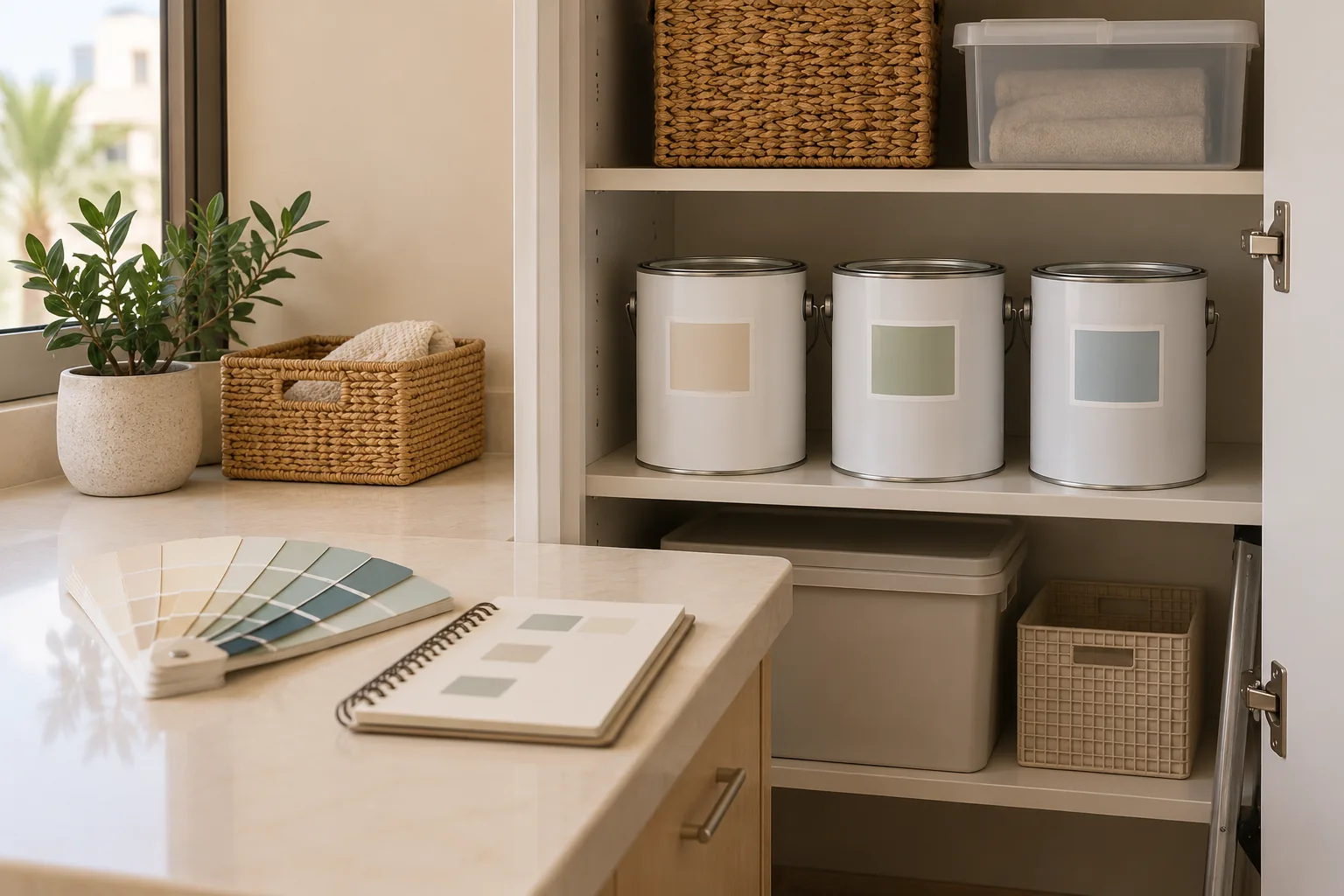
A balcony or rooftop storeroom in Kuwait may seem convenient, but shade does not guarantee a suitable temperature. Check the actual storage conditions. This guide concerns ordinary leftover wall paint; mixed epoxy and other two-component materials require their own instructions.
What should you write on the paint tin?
Give each colour a room-specific record. “Living-room beige” may describe several shades, so copy the colour code, product and sheen from the mixing label. Photograph the complete label before it becomes dirty or torn, and keep the image in a folder named after the room.
- Manufacturer and product name, not just the colour name.
- Colour code and available mixing information.
- Sheen, such as matt or satin, as specified for the product.
- The room and the wall or ceiling where it was used.
- Opening date and application date, if known.
Add these records to your materials and aftercare file, with a room photograph and supply invoice where available. This makes later maintenance requests clearer.
Check the actual storage temperature
Benjamin Moore’s storage guidance recommends a dry location away from direct sunlight, food and children, with reference to the product data sheet. It gives an indicative range of 15–27°C; this is not a universal range for every paint. Follow the instructions for the actual tin.
Does the storeroom become hot when the house is closed? Is it exposed to sunlight or accessible to children? Choose a location that meets the instructions. Do not leave tins in a car after work. A nearby air conditioner does not guarantee suitable storage if it is switched off for most of the day.
Seal the container without mixing different leftovers
Check that the rim is clean and the lid sound, then close the container according to the manufacturer’s instructions. Sherwin-Williams’ storage and disposal guidance explains the importance of a tight seal, recording the opening month and year, and avoiding temperature fluctuations such as those in a garage.
Do not combine paints simply because their colours look similar. Products and sheen levels may differ, and you can lose the original reference. Keep the sound original container and label. If it is damaged, ask the supplier for a compatible replacement and transfer all product information. Do not use a water bottle or food container that could be mistaken for its original contents.
Check the paint before touching up a scratch
Stored paint is not automatically usable. If you find unusual lumps, a clear change in consistency, or notice a spoiled smell during normal handling, stop and consult the supplier. Do not deliberately inhale the container or add random substances to restore it. Usable storage life depends on the product and conditions; there is no fixed number of years for every tin.
Even with a sound container and matching colour code, test an inconspicuous area and assess it after the specified drying period. If the patch remains visible, do not immediately enlarge it. Read why touch-up patches show and when to repaint the whole wall. Establish the limits of a repair before turning a small scratch into a conspicuous area.
A practical handover checklist
- Match each room’s tins and labels to the finishes actually used.
- Keep the colour information even when little paint remains.
- Ask the contractor for product-specific storage and care instructions.
- Choose a suitable storage location instead of leaving tins among construction waste.
- For later repairs, send photographs of both the wall and the label.
When arranging painting with Almusaileem Paints & Decor, discuss handing over material records before work begins. This helps organise maintenance; it is not a promise of a particular storage life or an invisible repair. Enquiries: 56510526.
Leftover paint FAQs
Must I keep every tin?
Keep paint that has a clear future use and can be stored correctly. To avoid buying excessive surplus, see how to calculate wall-paint quantities before ordering.
What should I do with paint I no longer need?
Do not pour it into drains. Ask the supplier or relevant local authority about disposal appropriate to the paint type in Kuwait. Collection programmes described on overseas websites do not establish that the same service is available locally.